
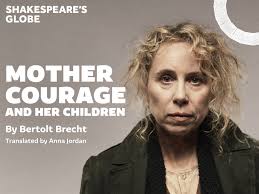
Bertolt Brecht’s Mother Courage and Her Children was written in 1939, as Europe moved toward the Second World War, although originally the play is set during the Thirty Years’ War, but its real target is modern capitalism, militarism and the way ordinary people are forced to survive. Through the character of Mother Courage, Brecht explores a central dialectical contradiction: she depends on war for her livelihood, but that same war destroys everything she loves.
The current Shakespeare’s Globe production, directed by Elle While and using Anna Jordan’s new translation, keeps Brecht’s anti-war argument but reshapes how it speaks to a modern audience. The Globe describes the staging as a “bold new” version with live music, Michelle Terry in the title role, and James Maloney’s original music. Instead of anchoring the story firmly in Brecht’s named seventeenth-century battlefields, Jordan’s adaptation removes country and place names, replacing them with grid references and colours, so that the war feels less like one historical event and more like a recurring human tragedy.
Brecht did not want theatre to be a place where audiences simply cried, identified emotionally with characters, and then left unchanged. His theory of dialectical theatre, closely connected to his better-known idea of epic theatre, was designed to make the audience think critically. Instead of presenting suffering as natural, eternal, or unavoidable, Brecht wanted to show that human behaviour is shaped by historical and economic conditions. More importantly, he wanted to show that these conditions can be changed.
In Mother Courage, war is not presented as heroic or noble. It is presented as a business. Mother Courage travels through the war zone with her cart, selling goods to soldiers. She is not a general, a ruler, or a rich war profiteer. She is a small trader trying to survive. Yet she is still part of the war economy. This is what makes the play so powerful: Brecht does not present her as simply good or evil. She is both victim and participant. She suffers from war, but she also tries to make money from it.
This contradiction is at the heart of Brecht’s Marxist vision. Marx argued that people’s lives and choices are shaped by material conditions: class, labour, money, ownership, and economic survival. Mother Courage does not choose freely in a moral vacuum. She lives in a world where war has become the market. If she wants to feed herself and her children, she must trade with the armies. But the more she ties her survival to war, the more she helps maintain the very system that destroys her family.
Each of her children is lost to the war in a different way. Eilif is praised for violence in wartime, but later punished for the same behaviour when peace briefly returns. Swiss Cheese is killed because of military loyalty and honesty. Kattrin, the silent daughter, dies while trying to save a town from attack. Through these deaths, Brecht shows the contradictions of a society ruled by war. The same actions can be called heroic or criminal depending on the needs of power. Morality is not stable; it is shaped by historical circumstances.
This is a deeply dialectical idea. Dialectics focuses on contradiction, movement, and change. Nothing in Brecht’s theatre is fixed. People, values, and institutions are shown as products of history. War creates certain kinds of behaviour, then punishes them when conditions change. Eilif’s violence is rewarded when it serves the army, but condemned when it no longer fits the political moment. Brecht uses this contradiction to show that morality under capitalism and war is often hypocritical. The ruling system defines “virtue” according to its own interests.
Mother Courage herself is also full of contradiction. She loves her children, but her obsession with business repeatedly places them in danger. When Swiss Cheese is captured, she bargains too long over the price of saving him. Her desire to protect her money conflicts with her desire to save her son. Brecht does not ask the audience simply to hate her for this. Instead, he asks us to examine the social conditions that produce such behaviour. Poverty forces people into cruel calculations. Capitalism turns even love into negotiation.
This is why Brecht’s theatre avoids simple emotional identification. In a traditional tragic play, the audience might see Mother Courage as a tragic mother destroyed by fate. But Brecht rejects fate. He wants the audience to ask: why does this happen? Who benefits from war? Why must ordinary people sell goods to survive in a system that kills their children? Could society be organised differently? These questions are more important than pity.
Brecht’s famous “alienation effect” helps create this critical distance. The songs, episodic structure, scene titles, interruptions, and sharp contrasts prevent the audience from losing itself completely in emotion. The play often tells us what will happen before it happens. This removes suspense and forces us to focus on causes rather than outcomes. We are not watching to find out whether Mother Courage will lose her children; we are watching to understand why she loses them and why she fails to change.
Change is one of the most important ideas in Brecht’s theatre. However, Mother Courage is striking because the central character does not truly change. By the end of the play, after losing all three children, Mother Courage continues pulling her cart. This is not meant to show heroic endurance. It is a disturbing image of someone trapped in the same economic logic that has destroyed her life. She has experienced suffering, but she has not gained political understanding.
For Brecht, this lack of change in the character is meant to produce change in the audience. Mother Courage does not learn, so we must. Her failure becomes a lesson. Brecht does not offer comfort or emotional closure. Instead, he presents a contradiction that remains unresolved on stage so that the audience feels compelled to resolve it in the real world. The play suggests that individual survival strategies are not enough. What must change is the social system that makes war profitable and poverty unavoidable.
This connects strongly to Brecht’s Marxist ideas about capitalism. In the play, war functions like a marketplace. Everything becomes a commodity: food, uniforms, loyalty, bodies, even children. Mother Courage’s cart is a symbol of this system. It is her means of survival, but also her burden. She pulls it from scene to scene, almost as if she is chained to the economic structure that exploits her. The cart gives her life, but it also keeps her moving with the war. She cannot escape because her survival depends on the very thing that ruins her.
Brecht’s dialectical theatre therefore refuses easy answers. Mother Courage is not simply a bad mother, nor is she simply an innocent victim. She is a contradiction created by a contradictory world. She wants peace for her children, but profit from war. She wants to survive, but survival requires compromise. She wants to protect her family, but the market teaches her to calculate everything in terms of cost and loss.
The play’s power lies in this exposure of contradiction. Brecht shows that war is not just a political event; it is an economic system. He shows that ordinary people are damaged not only by violence, but by the social relations that make violence profitable. Most importantly, he shows that what appears natural or inevitable is actually historical and changeable.
Mother Courage and Her Children is not a play that asks us to admire suffering. It asks us to understand it. Through dialectical theatre, Brecht turns the stage into a place of investigation. He reveals the contradictions between love and profit, survival and morality, war and business. Mother Courage keeps pulling her cart, but the audience is not meant to follow her blindly. We are meant to stop, think, and ask how such a world can be changed.
Nicholas Catlin
Mother Courage is currently playing at the Globe Theatre Summer 2026

